Global Elections Reveal Limits of Trump's Foreign Endorsements
Rejections in Brazil, Serbia, and Hungary suggest that presidential backing does not guarantee victory for allied leaders abroad.
By Kendra Wilson ·
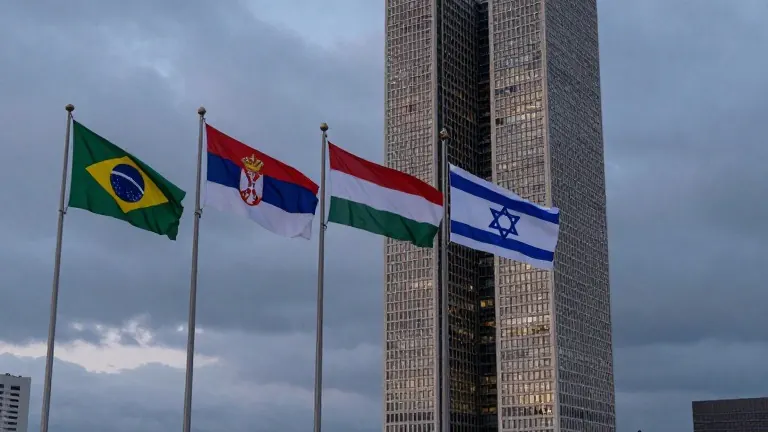
Presidential endorsements are failing to secure wins for allied leaders in key global elections this year. Brazilian President Luiz Inácio Lula da Silva won reelection on Sunday, defeating Flávio Bolsonaro, a Trump-aligned candidate whose father Jair Bolsonaro had also been a close ally of the White House. In Serbia, a student-led movement toppled the ruling party of Aleksandar Vucic last weekend, ending his time in power after serving as prime minister from 2014 to 2017 and president from 2017 onward.
Vucic addressed his defeat during a concession speech, attributing the loss to external forces. He claimed the result was a legitimization of a revolution carried out by the people with direct support from various European countries and the American deep state, which he said opposes President Trump.
The trend of rejected endorsements began earlier this year in Hungary. Vice President JD Vance visited the country for two days and publicly backed then-Prime Minister Viktor Orban. Orban, a staunch ally and recipient of Trump’s endorsement, lost that election and was removed from office after 16 years of leadership.
In Israel, Trump endorsed Prime Minister Benjamin Netanyahu for reelection in October. The results of the Oct. 27 vote are not yet final, but the Associated Press reported that Netanyahu’s Likud party appears to have lost its majority in the country’s parliament.
These outcomes stand in contrast to domestic Republican primaries, where Trump’s influence remains potent. In August, Trump claimed that 97% of Republican candidates he backed won their primaries. He has successfully challenged politicians he dislikes, including Sen. John Cornyn of Texas and Rep. Thomas Massie of Kentucky.
Experts argue that the disconnect between domestic and foreign influence stems from the nature of local voting behavior. Cas Mudde, a professor of international affairs at the University of Georgia, stated that elections are always national first, with regional or global factors being a distant second.
Stijn van Kessel, a professor of comparative politics at Queen Mary University of London, noted that it is unclear if Trump ever held strong influence over far-right actors abroad. He explained that such parties often celebrate each other’s victories to portray themselves as part of a global movement, but these relationships can sour quickly when national interests collide and the foreign partner becomes toxic to domestic voters.
Van Kessel pointed to the recent friction between Trump and Italian Prime Minister Giorgia Meloni. The dispute arose from Italy’s refusal to allow U.S. aircraft to use a NATO airbase for the war in Iran. Trump later claimed Meloni begged him for a photo at the G7 summit, a statement that prompted a denial from the Italian leader.
Far-right movements remain strong in several nations. In France, Marine Le Pen is the current frontrunner to succeed President Emmanuel Macron, according to a Politico poll compilation, though she has often started ahead of a crowded field before support consolidates around moderate candidates. In Germany, the far-right Alternative fur Deutschland party won 20.8% of the vote in the February 2025 federal election, making it the largest opposition party. Trump ally Javier Milei leads Argentina, and Colombia’s new President Abelardo de la Espriella was elected on a far-right platform.
Mudde observed that many far-right leaders disassociate from Trump when his popularity dips. Trump’s poll numbers remain near a record low in the U.S., driven by concerns over the Iran war and soaring energy prices affecting the cost of living. David Barker, a professor of government at American University in Washington, D.C., said voters give frustrated populations a chance with new leaders but move on when experiments fail. He added that at this point, Trump undermines his allies' ability to maintain support.
Source: CNBC