European Youth Protests Spread From France to Albania
Student-led marches across nine countries have turned violent in several cities, prompting governments to blame radical groups while citing education and housing costs as primary triggers.
By Mateo Castillo ·
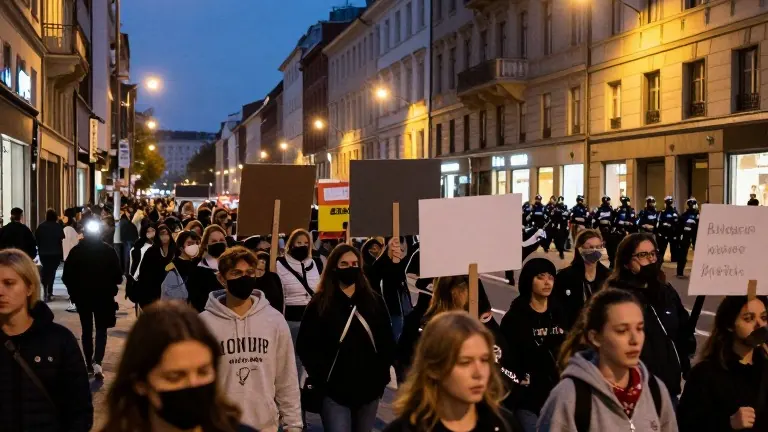
Youth-led protests have erupted across at least nine European countries in recent weeks, spreading from France to Albania in a span of more than 1,000 miles. While most demonstrations began peacefully, they frequently ended in clashes, with authorities reporting heavy use of tear gas and water cannons in cities including Brussels and Madrid.
The movement has drawn tens of thousands of participants, many of whom are students. In Madrid, a tent encampment has occupied a central square since late September. In Lisbon and Rome, thousands marched earlier this month. In Barcelona, over half of those detained during weekend scuffles were under the age of 18, according to Italy's LaPresse news agency. Minors were also among those apprehended in Milan.
Organizers have cited education grievances, social inequality, and rising living costs as primary motivators. Demonstrations are often coordinated ad hoc through TikTok and Instagram, a phenomenon Belgium's interior minister termed the "TikTokisation" of protests. France, where the current wave began in late September over staff shortages and building conditions, appears to be a key catalyst for neighboring nations.
Yiannis Papanikolaou, a 17-year-old pupil in Athens, told AFP that French actions would spur similar change in Greece. "School buildings are terrible and poorly maintained.. I think something might change," he said. In Barcelona, students used the hashtag #InstitutsIndignats, echoing the French slogan Lycées Indignés.
Economic anxiety extends beyond campus walls. Carolina Cruz, a 26-year-old PhD student in Lisbon, told Reuters she faces losing her home as her rental contract expires. "I'm the first person in my family to enter a doctoral programme and even with all the studying I've done, I still can't make it," she said. In Milan, 22-year-old protester Riccardo told AFP that the goal is to force public discussion of these issues.
Governments are responding with mixed tactics. Intelligence services in France and Belgium describe looting as opportunistic, while authorities in Italy and France have pledged to impose a "you break it, you pay for it" policy. Italian Prime Minister Giorgia Meloni has proposed making parents liable for damages caused by their children, including deductions from family welfare support.
Political responses vary by party. French President Emmanuel Macron and the center-right blame left-wing radical groups and "delinquents" for planning riots, while avoiding links to immigration. In Belgium, the nationalist party Vlaams Belang described the violence as "imported," blaming a failure of integration. Mark Leonard, director of the European Council of Foreign Relations, noted that unresolved crises from 2007 to the present have layered together, creating a sense of pent-up anger.
Nathalie Tocci, a politics professor at Johns Hopkins University, argued that young people are engaged in a grassroots way, similar to the Fridays for the Future movement. She pointed to Serbia, where student-led protests helped defeat long-standing leader Aleksandar Vučić in parliamentary elections. Fresh mass demonstrations are planned in France and Italy in the coming days.
Source: BBC News